Systematic investigations into the limits of human auditory perception and the physical properties of low-frequency sound waves in the early twentieth century led to the development of instruments capable of detecting sounds below the threshold of audibility, thereby opening up new fields of inquiry—namely, infrasound. While the human ear perceives sound within a frequency range of approximately 20 Hz to 20 kHz, infrasound occupies frequencies below this lower range, at less than 20 Hz. Its specificity lies in the fact that it operates at the edge of the perceptual field: in a domain where it escapes auditory detection yet remains present at the level of bodily sensation. Rather than being perceived as tone, infrasound manifests as vibration, pressure, or a subtle shift in spatial conditions. It is experienced through the body, as a presence that is simultaneously elusive and immediate. In this shift, sound ceases to function solely as an auditory phenomenon and instead becomes a somatic and spatial modality of experience.
Interest in infrasound—its natural sources (including atmospheric processes, geodynamic activity, and forms of biocommunication), as well as its effects on physiological and affective responses—has gradually expanded beyond the confines of scientific laboratories into the realm of applied and experimental practices. In these contexts, infrasound is increasingly mobilized as a medium for investigating experiences that unfold through space and the body, as an invisible vibration that the body registers before it can be symbolically articulated by the mind.
The exploration of phenomena at the limits of the perceptual field occupies a central position in the practice of Spanish artist Marc Vilanova, who conceives his installations as a kind of instrument—extensions of the sensory apparatus—aimed at expanding the framework of auditory and physical experience.
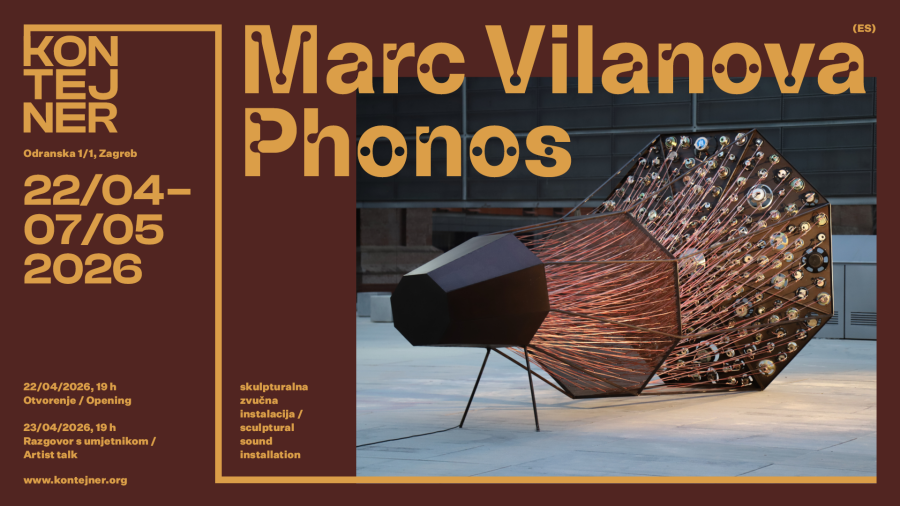
"Phonos" is a sculptural installation composed of 208 recycled loudspeakers, each of which has been reconfigured: its membrane removed and reprogrammed to receive a distinct infrasound signal. Unable to effectively transmit these frequencies into the air, each speaker reveals its own material operativity: the vibration of coils, the tension and movement of structural components, and the friction of metallic elements become the primary carriers of experience. An algorithmic system, inspired by collective behavioral patterns found in nature, coordinates their movements into continuously shifting polyrhythmic structures. In doing so, "Phonos" exposes sound as a physical and spatial phenomenon, displacing it from the realm of the audible into that of the tangible, while bringing to light the otherwise elusive dynamics of sound waves.
Despite its spatial monumentality, "Phonos" generates conditions for an intensely intimate experience, one that presupposes a reduction of external stimuli and a focused attention on the subtle variations in movement and vibration of individual elements. The installation thus assumes the qualities of a living organism—breathing and pulsating—creating a shared yet intimate experience between the human body and its acoustic environment. Through the practice of embodied listening, Phonos opens a space for rearticulating our relationship to sonic ecologies, fostering forms of sensory attunement and responsibility toward layers of the environment that typically remain beyond conscious perception.
IMPRINT
Organization: KONTEJNER | bureau of contemporary art praxis
Curator: Tereza Teklić | KONTEJNER
Technical realisation: Jakov Habjan, Camille Desjardins, Iago Franco Gonzalez
Design: Kuna zlatica
PR and social media: Inesa Antić


