What happens to an improviser when they are confronted with a digital mirror of themselves? How does the process of creating an interactive, co-creative musical software agent inform our understanding of the practice of free improvisation? And in what way does all this manifest itself in a performative context?
In Digital Doppelgänger, the artist has trained an interactive AI software with several years of their own double bass playing, allowing the algorithm to adapt their musical vocabulary to its cybernetic inclinations. They utilize an underlying computational framework to simulate improvisational behaviour, transforming the AI into an equal, a collaborator, a co-creator.
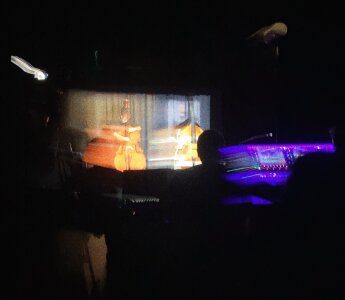
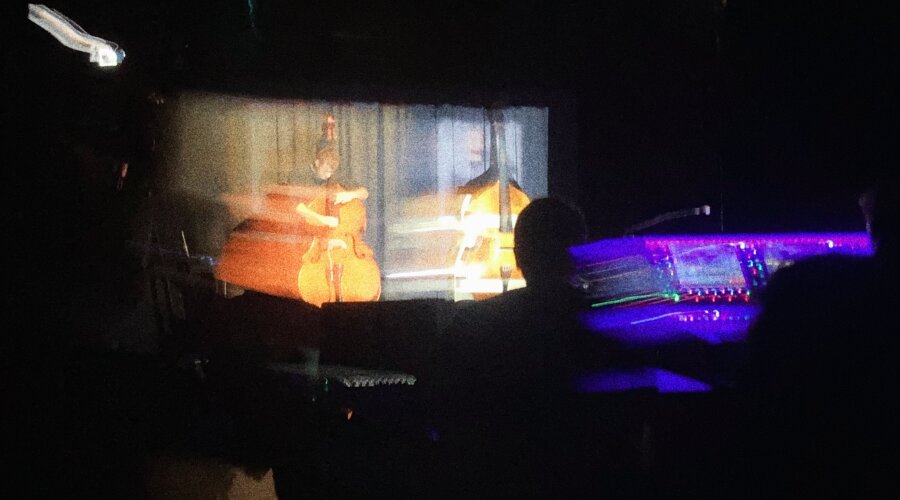
The AI also receives both a material and an ephemeral likeness of its creator. The sound is embedded into another instrument with a specially constructed framework prepared with contact speakers, and a distorted and computationally linked image of the artist is projected onto this structure, creating a symmetrical hierarchy, both acoustically and visually.
The Digital Doppelgänger project aims to employ technology in the pursuit of aesthetic research while subjecting technology to humanistic questioning and scrutiny. In this sense, the project seeks to provoke reflection on the approach of the digital age and its consequences for the development of aesthetic notions.
Digital DoppelgängerIvar Roban Križić (HR/AT)
Ivar Roban Križić (HR/AT)
Double bass player, composer, artistic researcher and curator based in Vienna. His practice includes free improvisation, electroacoustic and experimental music and artistic research of improvisation. He received his PhD in artistic research from the University of Music and Performing Arts Vienna, and is an active performer, pedagogue and curator of international projects and festivals.