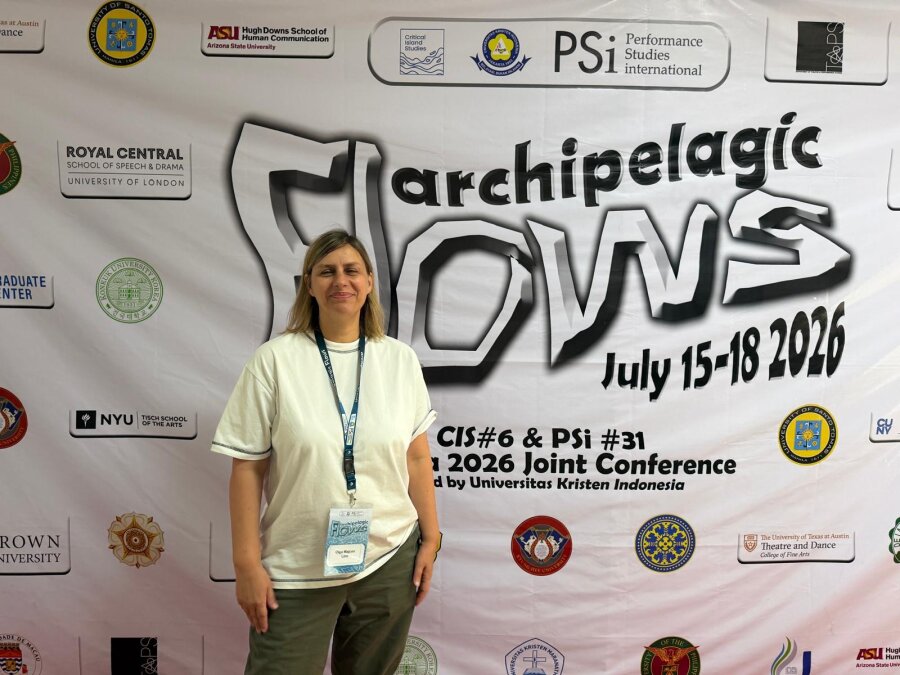
The international conference dedicated to the topic "Archipelagic Flows" organised by Performance Studies international (PSi) and Critical Island Studies (CIS), is being held this year at Universitas Kristen Indonesia in Jakarta. The conference brings together artists, researchers, and activists to discuss topics ranging from environmentally engaged performance practices to the geopolitical shifts shaping the arts.
On 16 July, Olga Majcen Linn will present the paper "Embodied Dissonance – Performing Goli island (Barren Island)".
The conference programme and book of abstracts are available via link. Further information about the presented paper can be found below.
___
"Embodied Dissonance - Performing Goli island (Barren Island)"
Dr. Olga Majcen Linn
KONTEJNER | bureau of contemporary art praxis, Zagreb, Croatia
This text explores how contemporary performance art, particularly through enactment, offers new aesthetic strategies for engaging with politically suppressed or traumatic pasts. It argues that enactment enables an embodied, affective approach to history—one that resists closure and instead activates dissonance, friction, and unfinished memory. Rather than restoring the past, these performances expose its ruptures and contradictions, proposing embodied dissonance as a strategy for confronting what has been culturally repressed.
Drawing on Brian Massumi’s understanding of affect as pre-conscious intensity that precedes
representation, embodied dissonance can be distilled as the simultaneous experience of conflicting affective intensities within the body—tensions that are not resolved or codified into coherent emotions or narratives. This unresolved affect circulates through performers and audiences alike, keeping difficult memory alive in a way that resists closure or reconciliation.
This approach is exemplified in Andreja Kulunčić’s performance on Goli Otok, a remote Croatian island that once served as a political prison in socialist Yugoslavia. Her reenactment, performed by three women, addresses the neglected history of the island’s female prisoners. By embodying the mechanisms of internalized violence—where prisoners were forced to punish one another—the piece stages complicity and survival as intertwined forces. Through repetition, gesture, and unresolved affect, the performance insists on the continued presence of the past, offering embodied dissonance as an aesthetic and ethical tool for rethinking collective memory.