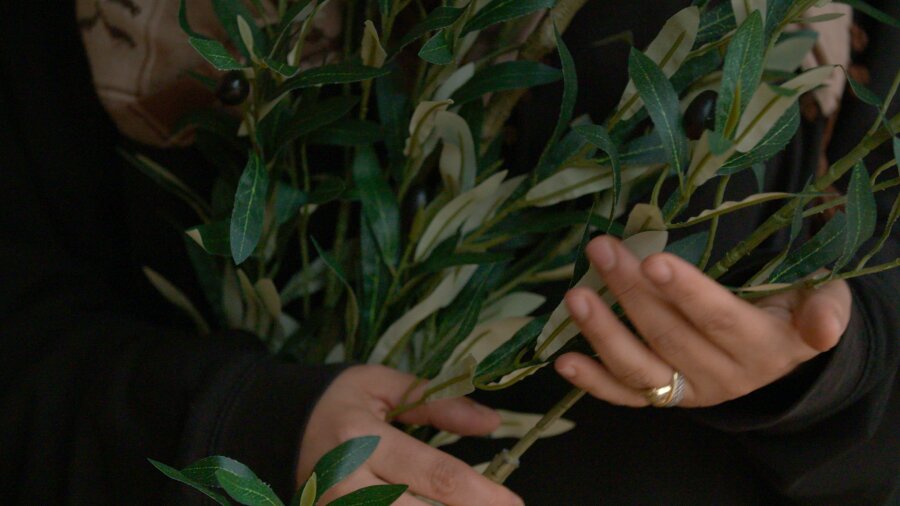
Borrowing a line from one of Diane di Prima’s "Revolutionary Letters", "We Hope (Between the Lines): The Yearning of the Conspirator" looks to shared experiences of violence and grief as a potential starting point for building solidarity. The exhibition brings together two collaborative films, each forged from alliances between the Middle East and former Yugoslavia.
Sanja Grozdanić and Basyma Saad’s "Permanent Trespass" enlists a pair of professional mourners (self-described “traveling eulogists”) to deliver a memorial for the American Century - a concept that is not tied so much to a specific geography as an ideology built on extraction and accumulation. A eulogy is supposed to bring with it finality, but here the idea of professionalized grief strips mourning of its intimacy and uniqueness, “returning death to the market” as just another product for consumption.
The two eulogists are periodically interrupted by what the artists call a “cine-poem”, a disembodied voice that rattles off the keywords that have helped prop up Western hegemonies - “Nakba”, “North Atlantic”, “Preventative Defense” - fragments of phrases that conjure up entire histories of violence and dispossession. References glide from Palestine to the “Beirut of the Balkans,” drawing correspondence between conflicts across continents.
Pary El-Qalqili & Marta Popivoda’s "ICH BIN HIER, ICH BIN DA" (2025), find ways to communicate without language. The film opens with a wordless introduction to its cast of women, whose expressions alone speak volumes. All are Palestinian and living in Berlin, where public displays of solidarity with their country of origin have been effectively criminalized. The women gradually open up to share their experiences of life “between the lines,” the specific bilocation hinted at by the title (which translates roughly to “I am here, I am there.”) Eyes mist with tears as the women recount the atrocities in Gaza, the attack on Al Shifa hospital, or the force inflicted on them or their children while attending rallies in Berlin.
These testimonies waver between desolation and hope. With nothing to barter but their lives - to quote another of di Prima’s Letters - these women view taking to the streets in protest as one of the only acts of collective grief available to them. The rallies allow them to build the kind of communities they have otherwise been denied. “Silence was never an option for me,” one woman confirms. “Silence would have killed me.”
Kate Sutton
"We Hope (Between the Lines): The Yearning of the Conspirator" operates under the umbrella of WHW’s larger program, Remember Freedom. Launched in 2025, this program draws on a 2014 speech in which author Ursula LeGuin urged society not to forget the freedom of artists - “the realists of a larger reality.”


