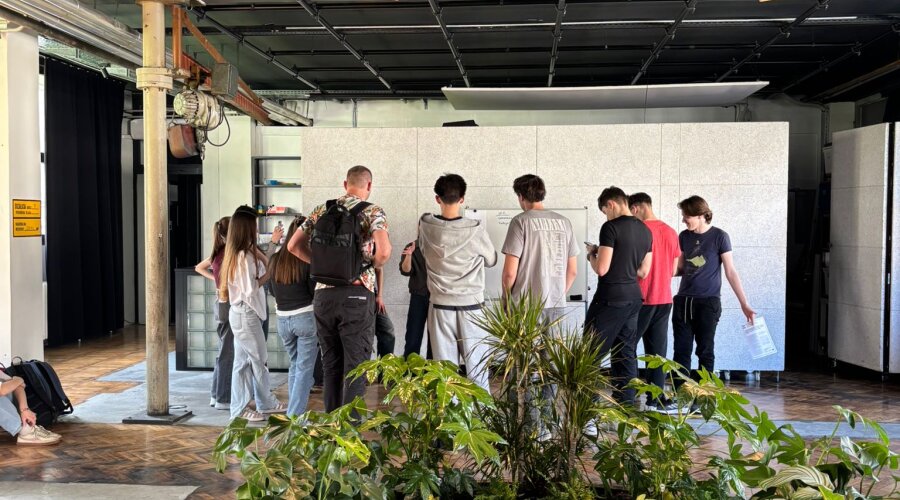
A workshop for secondary school students accompanying the exhibition of the interactive installation "Bionic Ecosystem. Kinships Between Plants, Machines, and Humans" by Spanish artists María Castellanos and Alberto Valverde [uh513].
The workshop consisted of a guided tour of the exhibition followed by a practical mapping activity. Students were introduced to the concept of plant intelligence and learned what constitutes our immediate ecosystem, how we influence it, and the ways in which plants within ecosystems learn and communicate – with one another, with other living beings, and with technology. Using an open-source GIS application and the cameras on their smartphones, students mapped the plant ecosystem in the immediate vicinity of the exhibition space. In doing so, they recorded the species and condition of the plants found there and investigated the various factors affecting them.
The aim of the workshop was to encourage students to reflect on the relationship between nature, technology and humans, and to demonstrate how contemporary art can contribute to a deeper understanding of the world around us by fostering creative and analytical engagement with a range of technological and scientific issues. The workshop was tailored to secondary school students (aged 14–19) and was linked to curriculum subjects including Art, Biology and Computer Science, as well as cross-curricular themes such as sustainability and ecology.
The workshop was organised by KONTEJNER in its exhibition space located in the former Vjesnik printing house in Zagreb, Croatia.
The workshop “Plant Intelligence and Mapping the Ecosystem” was part of the audience development programme "Spatial Mapping”.
The “Spatial Mapping” programme was co-funded by the Ministry of Culture and Media of the Republic of Croatia through the Public Call for Proposals for Programmes that Promote Audience Development in Culture in the Republic of Croatia.
