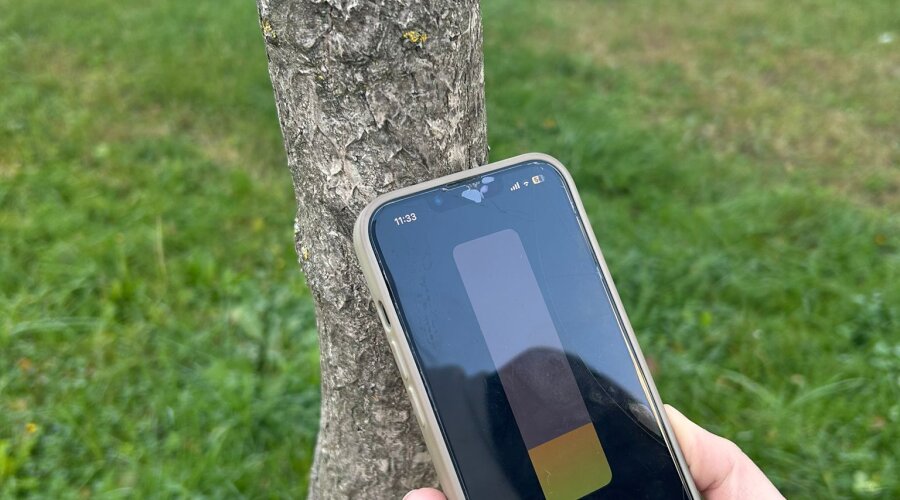
A workshop designed for secondary school students, accompanying the exhibition of the kinetic sound installation "SCAN" by Danish artist Christian Skjødta Hasselstrøm.
The workshop consisted of a guided tour of the exhibition followed by a practical session focused on spatial mapping and the exploration of the invisible digital environment. Participants were introduced to the concept of the digital environment, the elements that constitute it (devices that emit and detect signals), and the benefits and risks (both psychological and physical) associated with the development of digital technologies. Using open-source mobile applications and a digital archiving platform, students independently mapped the exhibition space by detecting invisible signals, exploring the hidden processes continuously taking place around us.
The aim of the workshop was to encourage students to reflect on how digital technologies shape our perception of space and to demonstrate how contemporary art can contribute to a deeper understanding of the world around us by fostering creative and critical engagement with a range of technological and scientific issues. The workshop was tailored to secondary school students (aged 14–19) and was linked to curriculum subjects including Art, Physics, Computer Science, and Sociology, as well as cross-curricular themes such as digital literacy and information and communication technologies (ICT).
The workshop was organised by KONTEJNER in its exhibition space located in the former Vjesnik printing house in Zagreb, Croatia.
The workshop “Mapping the Invisible Digital Environment” is part of the audience development programme “Spatial Mapping”.