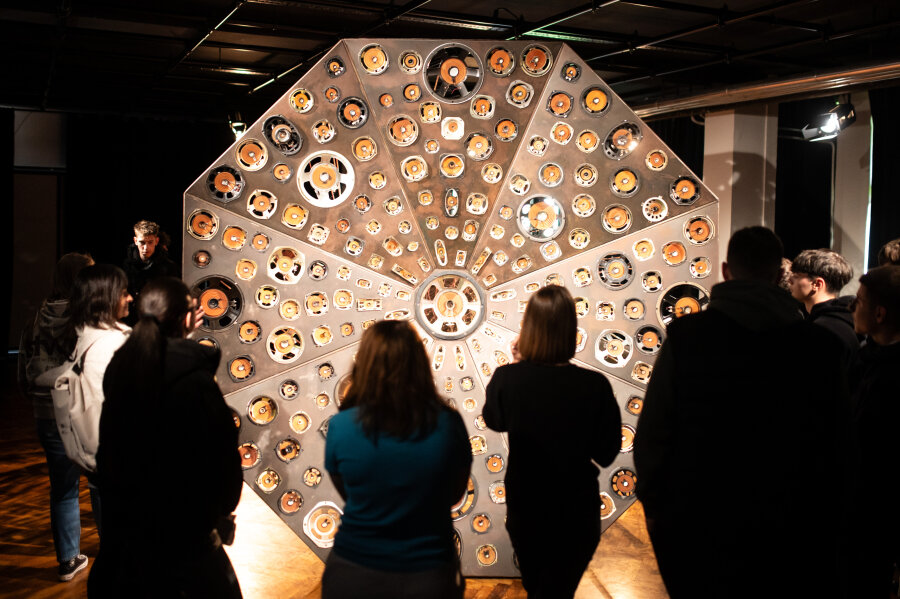
The programme combines guided exhibition tours with spatial mapping workshops using technologies employed or explored by the exhibiting artists in their work. Through an interdisciplinary approach, students examine the relationships between art, science and technology, while developing creative and critical thinking, as well as new ways of perceiving the spaces around them.
During this school year, we organised a total of 15 workshops for students from six secondary schools in Zagreb. Themes explored so far have included: Mapping the invisible digital environment alongside the exhibition "SCAN" by Christian Skjødt Hasselstrøm (DK), Plant intelligence: how plants learn and communicate alongside the exhibition "Bionic Ecosystem: Kinships between Plants, Machines and Humans" by María Castellanos (ES) and Alberto Valverde (ES), and Mapping sound: how we hear, see and feel sound alongside the exhibition "Phonos" by Marc Vilanova (ES). The mapped spatial segments created during the workshops will be made publicly available at the end of 2026 through a digital mapping platform currently being developed by artist Mihael Giba.
It is particularly important to us that, alongside working with young people, the programme also fosters collaboration with students and artists, creating opportunities for new connections between education, art and the cultural sector. In this post, we also share photographs from the sound mapping workshops held on 29 April 2026 for students from the Private Grammar and Vocational School Svijet and The First Gymnasium Zagreb. The workshops were led by Ivana Šešlek (KONTEJNER), with support from students Tonka Špoljar and Tereza Šarić from the Academy of Applied Arts in Rijeka, while the practical component of the workshop was conceived by artist Antonio Kutleša.
We look forward to new collaborations, encounters and workshops awaiting us this autumn as part of the continued development of the Spatial mapping programme!
