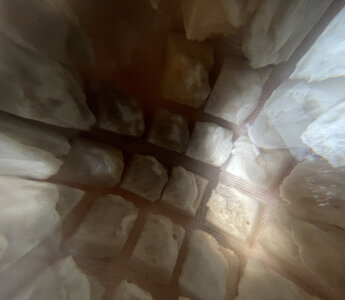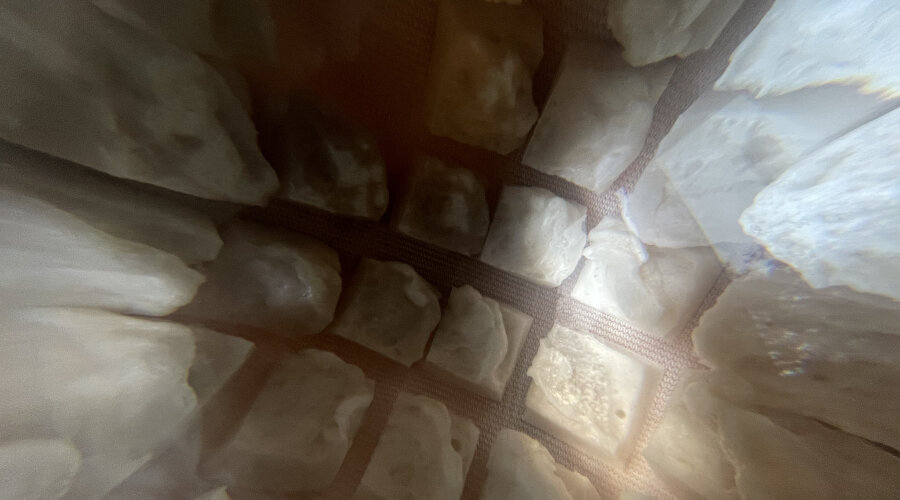
The textile installation Altermorrow is a simplified visualisation of an abstract idea – a complex speculative concept re-examining human life in an interior of the future. Departing from the premise that living spaces will become growingly scarce and increasingly uniform, while our habits, desires and tastes will change and become increasingly complex and elaborate, led to the idea of a machine that would respond to these changes. An organism outside of our own that envelops us and keeps us safe. We are used to looking at our living space as an unchangeable, static creation, existing in its final form. But what if we start observing our living space as an amorphous, flexible entity changing its shape and properties according to human needs?
The project is conceived as an experiment, forming a part of research that attempts to answer questions about the future of housing and being, human communication with technology, the inclusion of biological processes in the design of our environments, and the matter of the diversity of our needs and of us in general – by means of speculative practice.
As a versatile and adaptable material, textiles are perfect for this type of experiment. It keeps us warm, we sit or lie on it, cover ourselves with it, protect ourselves from outside effects and express our personal style. It has been present in our lives since the humankind found a home.
In addition to visual language and potential functions the work examines, the author is interested in human communication with the installation Altermorrow and reactions to the various movements with which the installation follows movement and/or responds to it. This response creates the impression that the machine has a will of its own and that, at a certain moment, for reasons unknown, it changes its attitude towards the person it observes. This “disobedience” is, of course, pre-programmed according to previously entered parameters. Thus, selection is based on physical characteristics, motor functions, emotions, etc. of the visitors. It seems as if the machine is discriminating against some individuals, and the author believes this will produce different reactions among people living in a user society. In a way, it is a critique of productive society that, in its desire for maximum efficiency, forgets how many beautiful conclusions were created from mistakes.
Produced by: KONTEJNER
Associates: Peter Zobec, Branislav Panić
Sponsors: RPS d.o.o., Inplet d.o.o., Hennlich d.o.o., Medius d.o.o., OPL d.o.o.
Special thanks to: Brajak family, Ana-Marija Vašiček, Milan Žunić, Jelena Radić, Anamarija Šiša, Staša Popovič, Nina Glavič