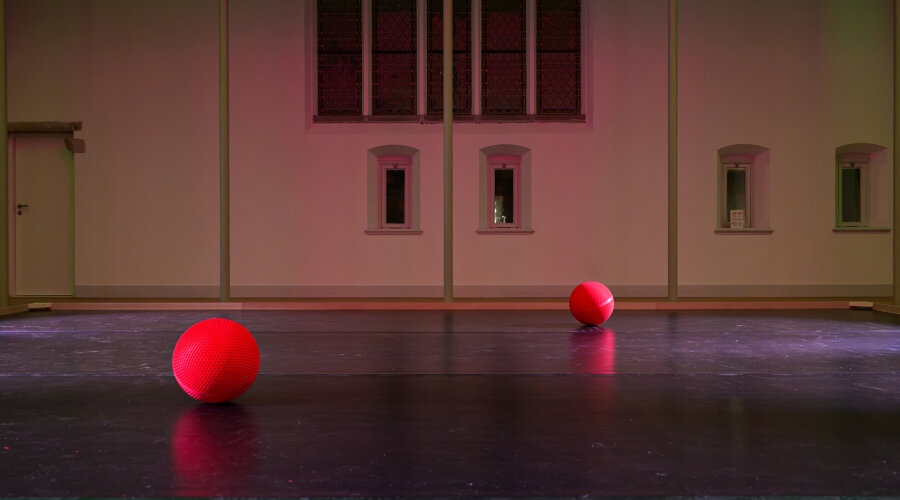
Is This Life? is a distributed monolith: a visually unified constellation of spherical robotic objects, each sphere being a unique, hand-crafted ceramic sculpture. Monolithic in presence and form yet dynamic in behaviour, the objects conceal the mechanisms that drive them, moving and interacting according to the Boids algorithm—a computational model of collective flocking behaviour. Through direct experience, visitors are invited to gradually uncover the principles governing their actions.
Is This Life? questions the boundary between the living and the non-living as an unstable category shaped by historical, technological, and scientific conditions. Rather than simply asking whether a robotic swarm resembles life, the work considers whether interaction, self-organisation, and collective behaviour themselves can be understood as forms of vitality. In a world where an increasing number of non-living entities participate in shaping our decisions, behaviour, and everyday lives, this boundary no longer appears as a fixed definition but as a site of continuous negotiation.
The spherical objects function as materialisations of the “black box” concept: externally they reveal neither orientation, sensors, locomotion mechanisms, nor the technology that animates them. Their abstract form conceals a complex technological infrastructure, shifting attention away from technology itself and towards the relationships it generates. The carefully considered scale of the spheres allows them to establish spatial relationships with the human body within the gallery space while maintaining a high degree of visual abstraction.
Through movement and mutual interaction, the spheres create a constantly evolving situation in which human presence, robotic behaviour, and spatial conditions continuously shape one another. Rather than imitating life, Is This Life? investigates the criteria by which vitality is recognised, attributed, or denied, opening a speculative space for imagining new relationships between humans, technology, and non-human systems.
Collaborators
Hardware: TU Delft – Hanjo Claassen, Marcos Merino Francos
Software: LARICS Lab – Marko Križmančić, Stela Periš
Ceramic spheres: Rino Banko
Special thanks: Teun Verkerk and Tamara Petrović
Produced by: iii (instrument inventors initiative) and Highlight Delft, with the support of the Crossing Parallels programme, the Ministry of Culture and Media of the Republic of Croatia, the City of Zagreb, and the Kultura Nova Foundation.


