Every new work begins as an encounter between uncertainty and a strong inner drive. The moment when an idea leaves the sketch and takes material form, occupying real space, marks the beginning of a process in which a system developed over many months starts to operate according to patterns that only then become visible—often quite different from those I had initially imagined.
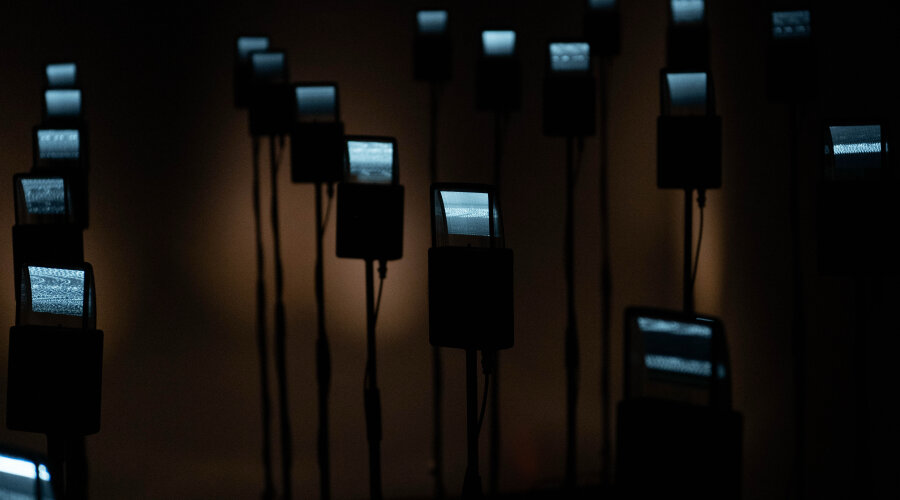
This multi-channel video installation consists of 46 black-and-white screens salvaged from video intercom systems. Removed from their original housings, the screens are mounted within a newly designed open frame that exposes them from every side, including the reverse, where the video image remains visible. The screen thus ceases to function merely as a display surface and instead becomes a spatial, sculptural object that occupies and shapes its surroundings.
Each screen is connected within a unified system that allows every device to receive an independent visual signal. This structure functions not only as a technical image distribution system but also as a dynamic field of relationships between the individual screens and the space they collectively define. The system enables synchronised transformations across all monitors, creating complex choreographies of moving images: content travels from screen to screen, shifts through rows and columns, circulates, contracts, and expands. The visual flow becomes a spatial composition in which the image is experienced not as an isolated projection but as a process that moves, disintegrates, and reconfigures itself across a network of displays.
In this sense, the work functions as a multi-channel video instrument. Rather than presenting a fixed linear projection, the system allows images to be performed in real time—composing rhythms, repetitions, interruptions, and relationships between the screens and the surrounding space. Each monitor becomes an individual voice within a larger visual structure, while the installation as a whole behaves like an instrument that can be played, improvised, and continuously reconfigured.
Screen housing design and 3D printing: Branimir Štivić
Technical support: Ivan Čadež, Fran Masnjak, Branimir Štivić
Co-production: KONTEJNER
Produced with the support of the Ministry of Culture and Media of the Republic of Croatia and the City of Zagreb.


