The Dragon’s Gold, the Goblin’s Emerald is a sound installation inspired by the Hikarigoke moss (Schistostega Pennata). This moss grows in caves and its unique quality stems from its lens-shaped cells. This gives the impression that the moss glows with an emerald green radiance when viewed from the angle from which it receives daylight. It is precisely for this reason that it earned the nicknames “dragon’s gold” and “goblin’s emerald”. These names also arise from the stories surrounding its discovery: cave explorers, observing the green glow suddenly appear and vanish, thought they were hallucinating or witnessing a supernatural phenomenon—hence the references to the dragon and the goblin.
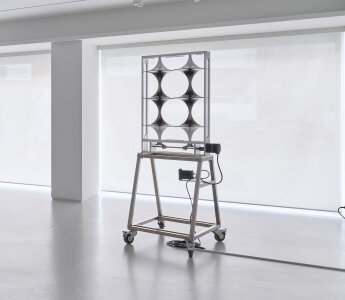
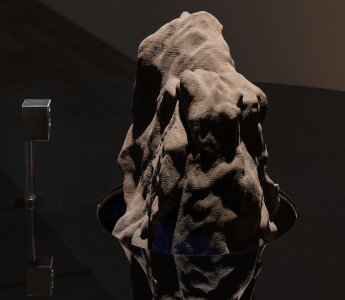
Using light, temperature and humidity sensors, the installation takes into account the environmental conditions of the Hikarigoke. These conditions will control a series of small modules that produce sound solely through vibration, without the use of speakers. These vibrating modules are made up of motors and natural materials (wood, rocks). The diversity of materials and vibration frequencies produces harmonies and a composition in real time.
The entire installation is designed to recreate an environment conducive to the growth of this extremely fragile moss. Through both sound and visuals that seek to recreate the interior of a cave, the installation evokes a sense of intimacy, vulnerability and fragility. Here, the aim is to recreate a moment in which time seems to stand still—an intimate, fragile and uncertain moment.
Produced by: KONTEJNER